Record 0211Field dossier

Morobong Community Food Garden

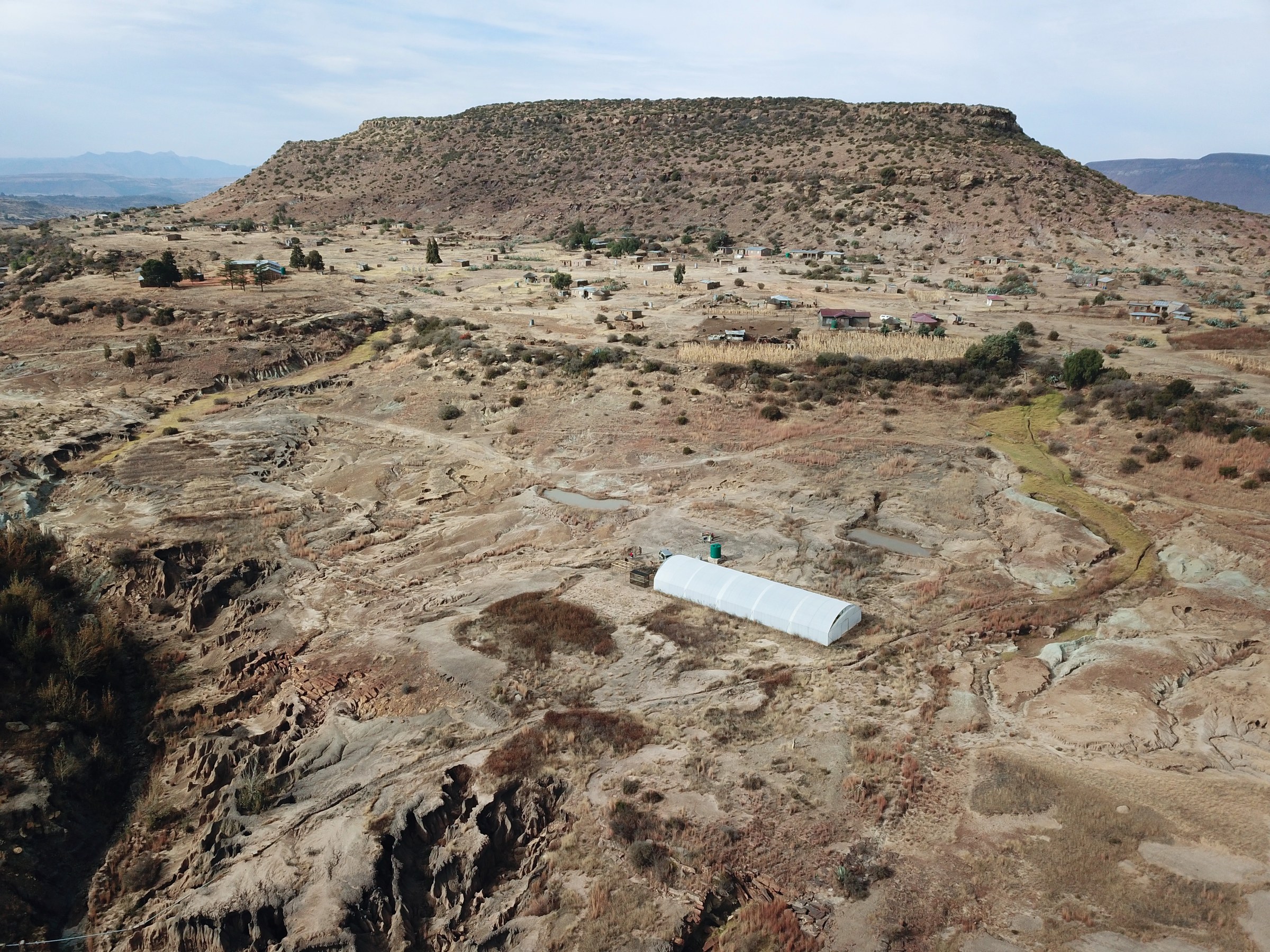
Oblique drone frame of a bare, pale hillside: a white polytunnel with a green water tank and a bakkie beside it at the centre, deep eroded gullies cutting the ground at the left and in the foreground, two shallow scrapes holding water, and a village of small houses and a stand of trees below a flat-topped mesa on the skyline
Programme
Reducing Vulnerability from Climate Change in the Foothills, Lowlands and the Lower Senqu River Basin · UNDP Lesotho, funded by the Global Environment Facility
Role
Permaculture International Consultant · site strategy & training
Place
Morobong, Khoelenya, Lesotho
Period
RVCC delivery Feb 2020 – Oct 2021 · aerial record to March 2023

8,000

vetiver plants recorded at the site

Read from RVCC Permaculture Project Close-out Report, October 2021

Shown here

  • Registered aerial pair
  • Satellite series
  • Ground record · 17 plates
  • 3 field films

Read from

  • Close-out report

At Morobong, a UNDP Lesotho project funded by the Global Environment Facility, the team built ponds and stone beds, planted 8,000 vetiver slips and 120 trees, and trained the community garden group. The 2021 works are documented in the close-out report, ground photographs and aerial comparisons from 2020 to 2023.

Site overview · Rory Clark’s drone archive · March 2020 to March 2023

Morobong: the site changing over time

Aerial comparisons of Morobong from March 2020, October 2020, October 2021 and March 2023, showing changes to the earthworks and garden infrastructure.

Read the clip transcript

5 March 2020 — before. 5 March 2023 — after. 21 October 2020 — early site works. 5 March 2023 — after. 1 October 2021 — after earthworks and vetiver planting. 5 March 2023 — after. The slider returns to March 2020 and repeats.

Project frame

The brief.

The slope had exposed rock, crusted subsoil and erosion channels. Garden establishment required earthworks to capture runoff, retain soil and prepare planting areas.

Rory’s remit

Rory was the programme’s permaculture consultant, responsible for site assessment, water and earthworks design, planting selection and five days of practical training for the community garden group.

Programme context

Morobong was one of twenty programme gardens. This phase covered about forty percent of the property.

Project record

The close-out report documents delivery at Morobong. Ground photographs and later aerial surveys record the site’s condition from 2020 to 2023.

Project close-out report, Rory’s photographs and aligned drone images from three dates.

Work in practice

Earthworks, planting and training

  1. Hold water on site

    Connect the spring, install tanks and drip irrigation, and cut two ponds to keep stormwater on the site.

  2. Shape the hard ground

    Use four days of TLB work to open access, cut tree holes and shape the pond and bed platforms in hard ground.

  3. Stabilise and plant

    Build stone-edged raised beds, then establish 8,000 vetiver slips and 120 fruit, nut and indigenous trees across the water-holding system.

  4. Equip the community

    Provide a micro-nursery, fencing, tools, seed, four beehives with suits and five days of practical permaculture training.

The ground record

What it looked like from a metre away.

Surveying, pond excavation, stone-bed construction and planting at Morobong in 2021, followed by a return visit in March 2023.

Dates come from the files’ capture records. The ground sequence follows the works. The separate first-visit photograph records the earlier community meeting in March 2020.

  1. Oblique drone frame of a bare, pale hillside: a white polytunnel with a green water tank and a bakkie beside it at the centre, deep eroded gullies cutting the ground at the left and in the foreground, two shallow scrapes holding water, and a village of small houses and a stand of trees below a flat-topped mesa on the skyline

    Plate 01

    15 June 2021

    Morobong at the start of the June 2021 survey, with a polytunnel, water tank and vehicle on mostly bare ground. Erosion gullies and two shallow pools are visible.

    Ground record

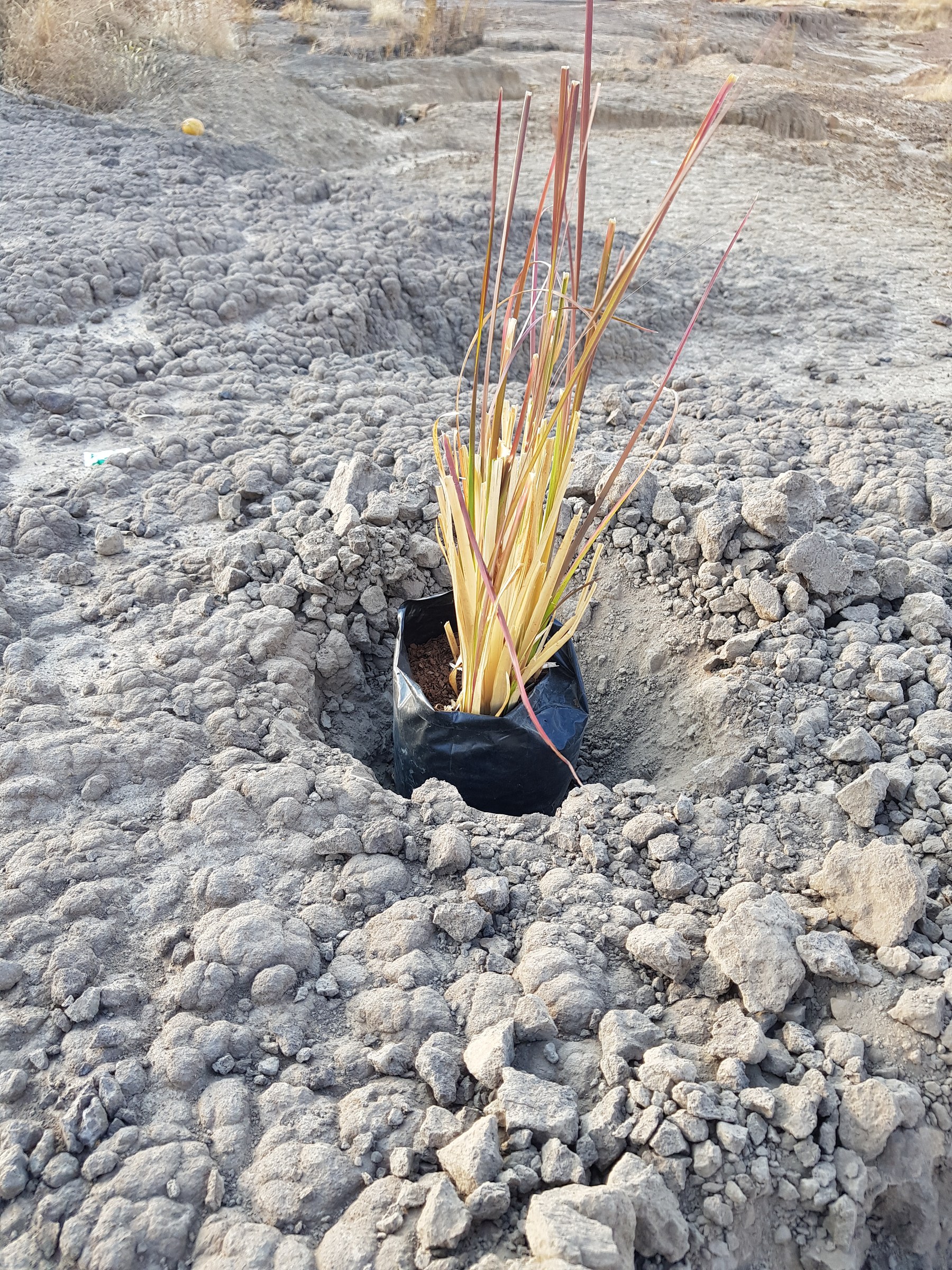
  2. Close view of a single vetiver slip, its leaves cut back to a fan, set into a planting hole dug through broken angular pale-grey rock rubble with no soil visible around it
    0216 June 2021
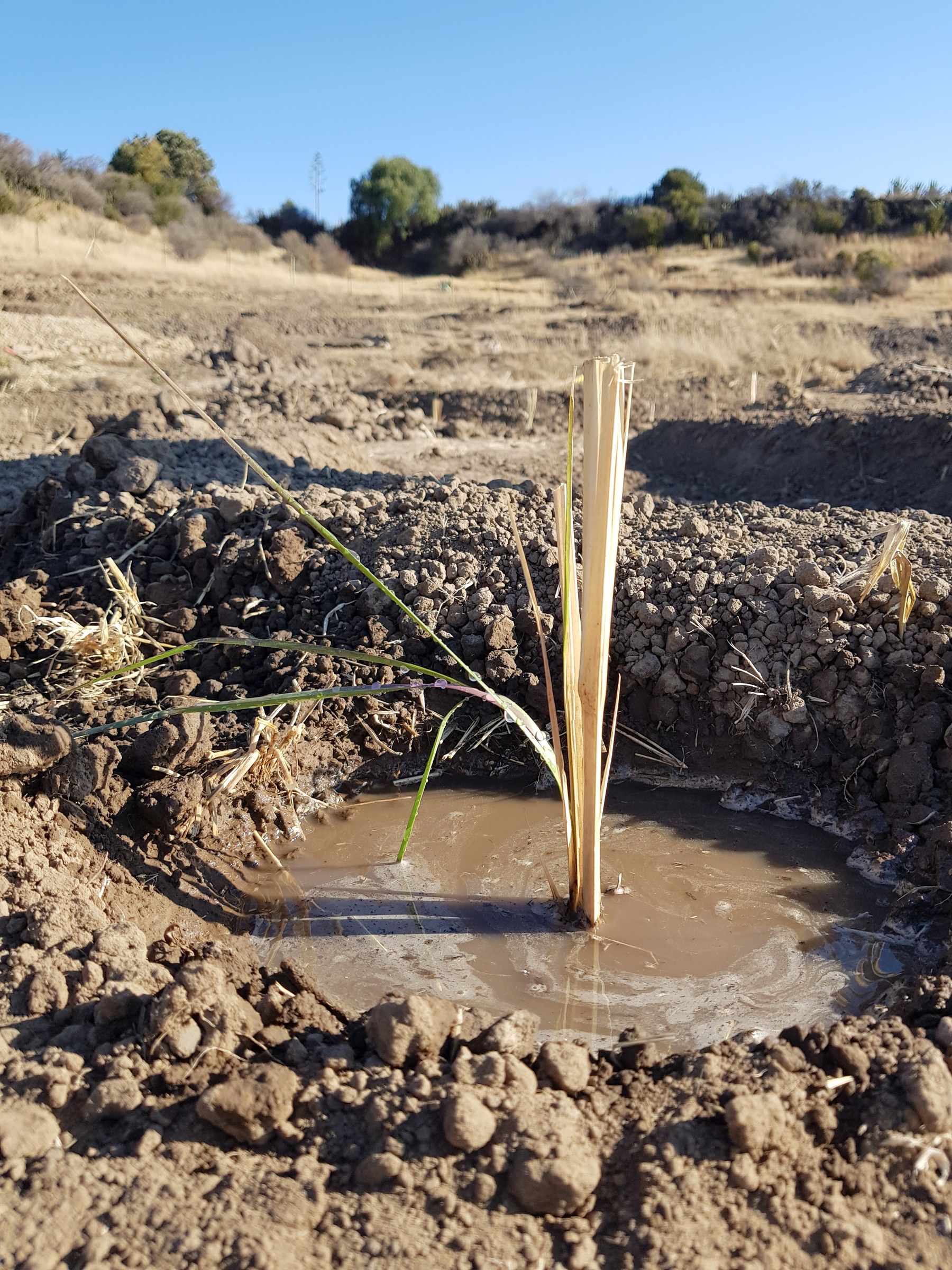
    A single vetiver slip, its leaves cut back to a pale fan with one green blade arching to the left, standing in a puddle of muddy water in a planting hole dug through dark clods of soil; bare worked ground with marker stakes, dry grass, a line of trees and a clear sky behind
    0325 August 2021

    Plates 02 · 03

    16 June 2021 · 25 August 2021

    02A vetiver slip with trimmed leaves planted in a hole through pale, broken rock.

    03A newly planted vetiver slip in a watered hole, with trimmed leaves and one green leaf visible.

    Ground record · pair

  3. Plate 04

    18 June 2021

    A backhoe excavating wet material from a pond, with the polytunnel and a green water tank behind it.

    Ground record · clip

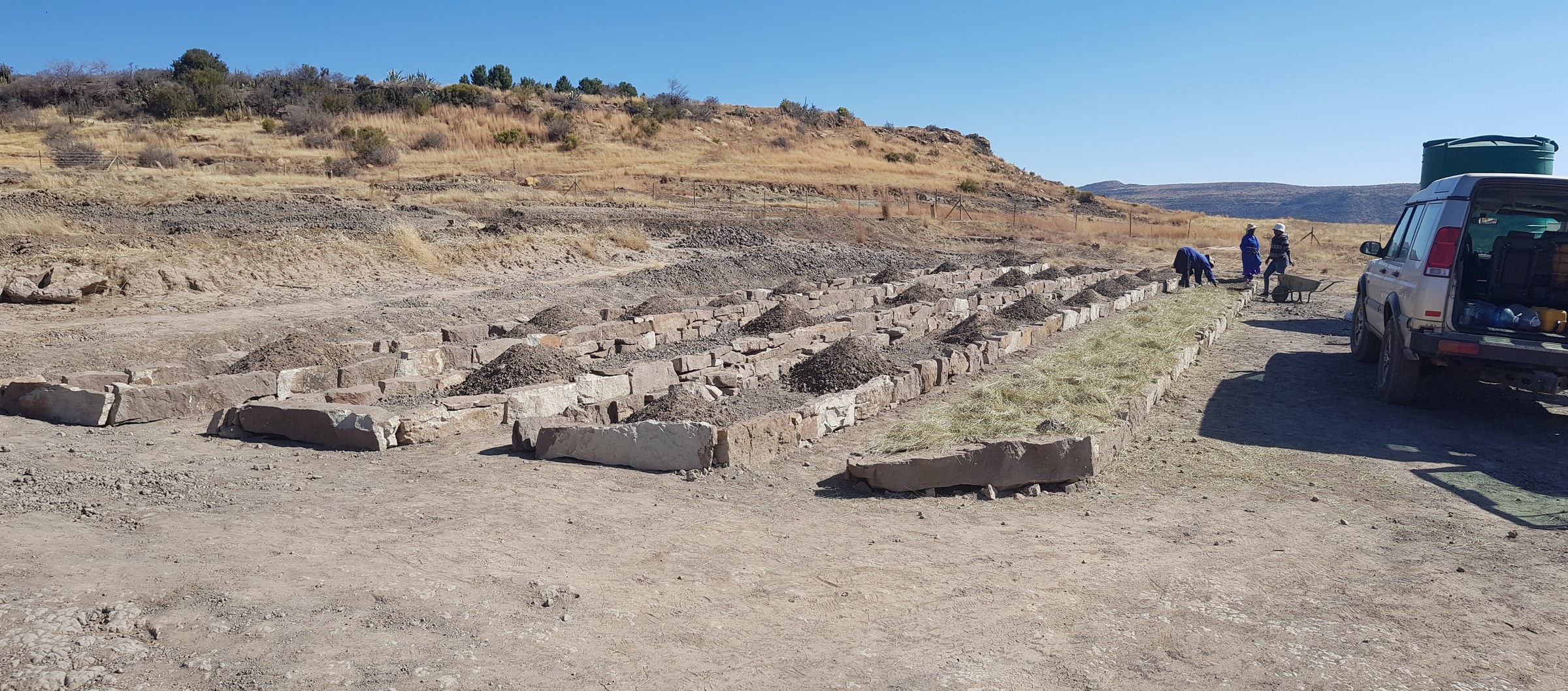
  4. Panorama looking along several parallel rows of dry-stone-walled raised beds under construction on bare graded ground, with a vehicle and people at the far end and a ridge behind

    Plate 05

    12 August 2021

    Parallel raised beds under construction, with walls of dry-stacked stone on graded ground.

    Ground record

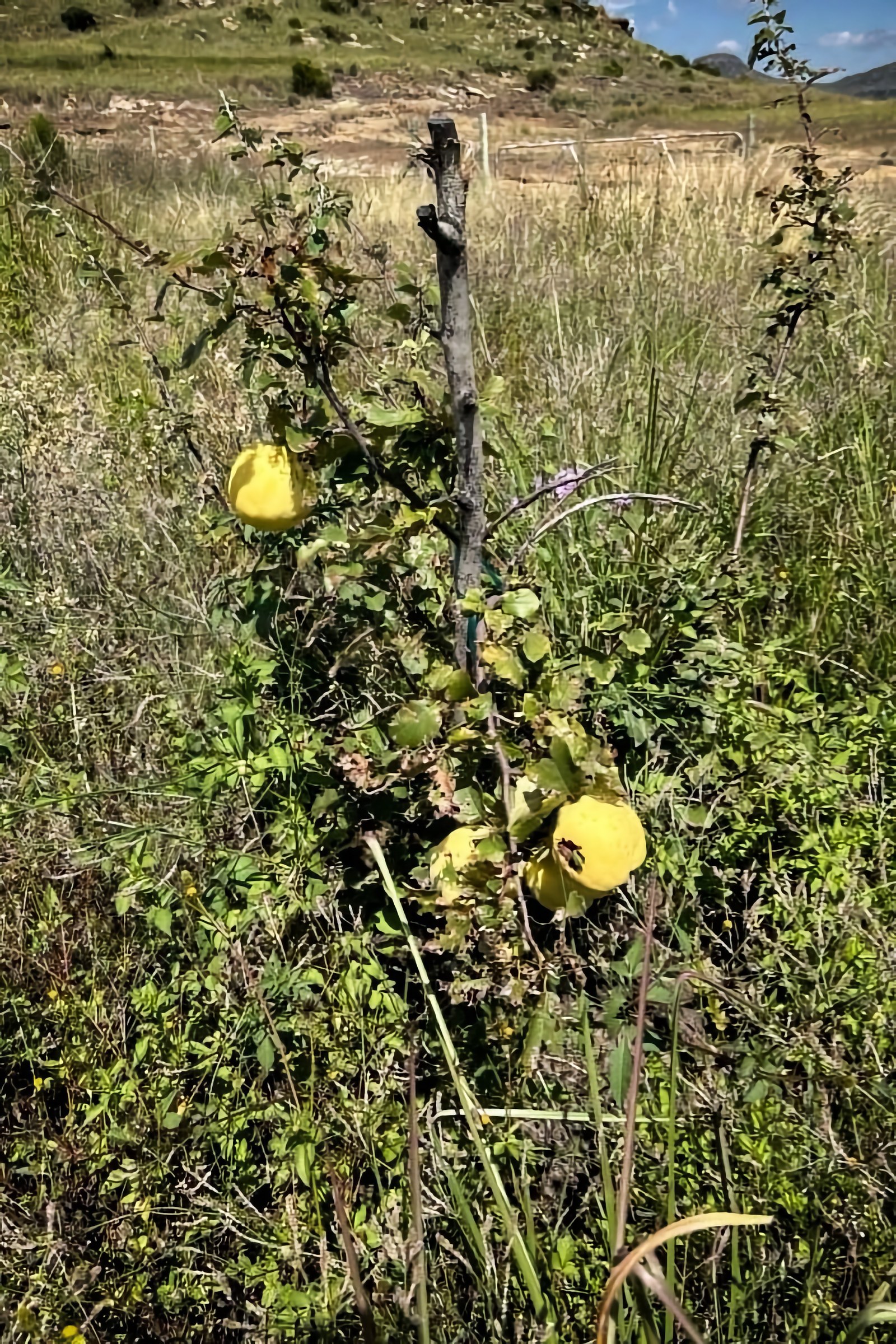
  5. A young staked tree a little over head height carrying two heavy yellow fruit among green leaves, standing in tall grass with a rocky hillside behind

    Plate 06

    5 March 2023

    A staked quince tree bearing two yellow fruit, photographed on the March 2023 return visit.

    Ground record

The planting list

Planting and equipment

Site quantities are taken from the October 2021 close-out report. Species listed only for the wider twenty-garden programme are identified separately from those recorded at Morobong.

Read from the RVCC Permaculture Project Close-out Report, October 2021: the Sedi la ka Mponesetse tsela (K3) entry under Garden examples, and Tables 8 to 11.

  • Vetiver8,000 slips

    Chrysopogon zizanioides, vetiver grass

    Planted along contour lines, field boundaries and pond banks. The ground photographs show individual slips and later hedges.

  • Fruit and nut trees70 trees

    Persimmon · Cherry · Plum · Hazelnut · Almond · Walnut · Pecan

    Species named for Morobong. The wider programme supplied thirty varieties: almond (Nonpareil, Ne Plus Ultra), apple (Granny Smith, Top Red, Golden Delicious), apricot (Bulida, Royal), cherry (Sweet, Lapins), fig (Adams, White Genoa), hazelnut, nectarine, olive (Mission, Frantoio), peach (Cling, Red Cheek), pear (Bon Chrétien, Packham), pecan (Barton, Ukalinga), persimmon (Izu), plum (Santa Rosa, Red Gold, Wickson), pomegranate (Wonderful, Corbon), prune, quince and black walnut. Deliveries across the programme ran from 27 June to 17 September 2021.

  • Indigenous trees50 trees

    Buddleja salviifolia, sagewood · Searsia lucida · Calpurnia sericea · Searsia pendulina, white karee · Halleria lucida, tree fuchsia (lebetsa) · Senegalia caffra, hook-thorn · Dovyalis caffra, Kei apple · Olea africana, wild olive · Searsia lancea, karee · Vachellia karroo, sweet thorn

    The wider programme’s ten species, chosen for firewood, nectar for bees, forage and nitrogen. The Morobong report records fifty indigenous trees, including indigenous fruit trees.

  • Berries and vines

    Blueberry · Blackberry · Goji berry

    Named for Morobong. The report says strawberries, three grapes and kiwifruit went to all twenty sites as well, planted between the trees on the drip lines.

  • Herbs

    Mint · Rosemary · Lavender · Yarrow · Pigeon pea · Comfrey

    Programme herb selection, planted in and around tree basins.

  • Seed30 vegetable types · 8 cover crops

    Open-pollinated and heirloom vegetable seed · Cover and forage crops · A micro-nursery with seedling trays and organic seedling fertiliser

    Morobong’s recorded quantities. The wider programme supplied forty vegetable varieties, two fruit varieties and nine cover and forage crops, with seed-saving bags and tubs.

  • Bees4 hives

    Four beehives · Bee suits · Hive tools

    The Morobong entry records four hives, bee suits and hive tools. Across the programme, sixty-two hives were supplied, with occupation by bees noted in the close-out report.

Open the project file

Site designs, photographs and films.

Open images to inspect the original designs and photographs.

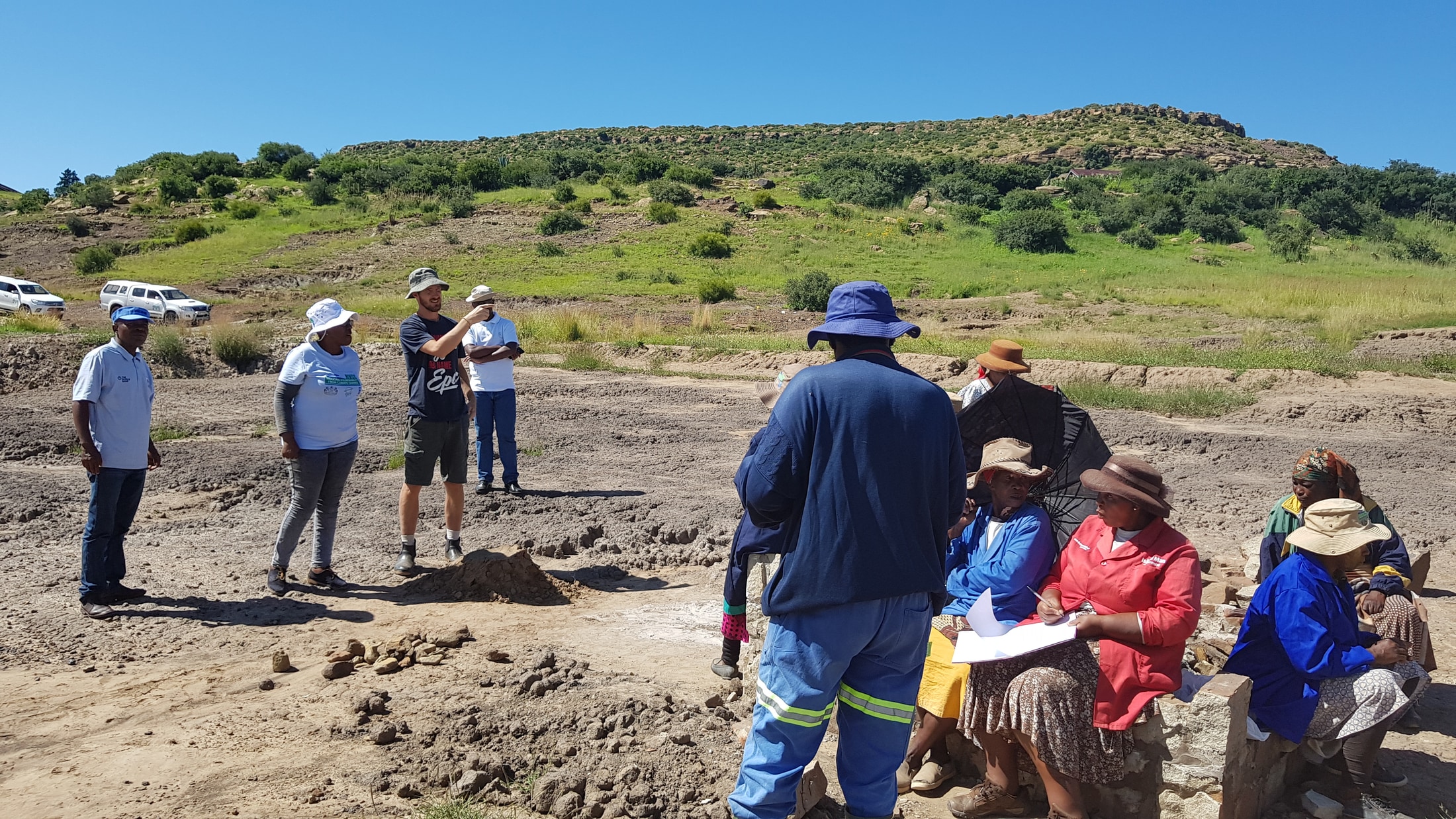
Rory Clark discussing the bare Morobong site with community members on his first visit
Plate 01 · First site visitMy first visit to Morobong

5 March 2020. Rory meeting community members on his first site visit, before the later survey, earthworks and planting.

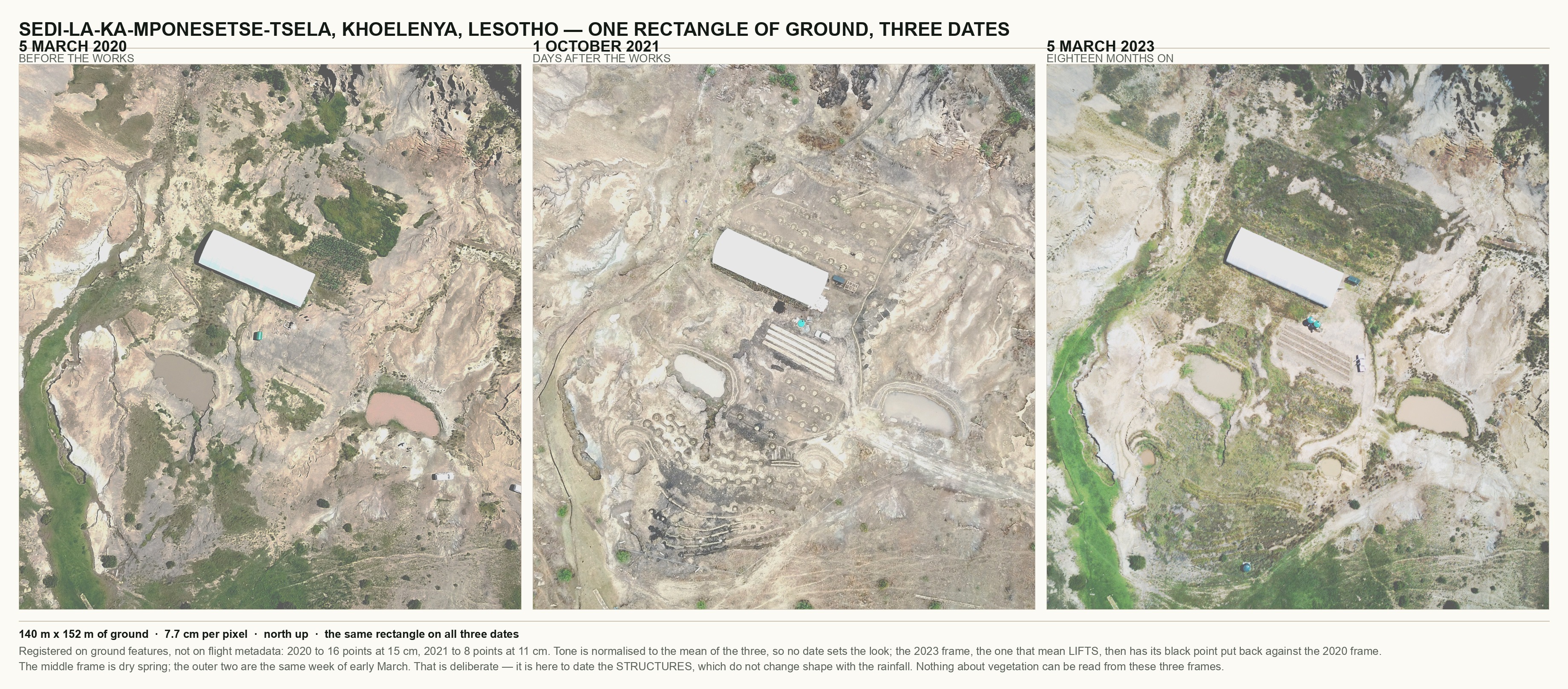
Three overhead drone frames of the same 140 by 152 metre rectangle of ground at Morobong — bare hillside on 5 March 2020, raw earthworks with ponds, contour basins and freshly cut planting beds on 1 October 2021, and the same structures grown in on 5 March 2023
Plate 02 · Registered aerial seriesSite development: 2020, 2021 and 2023

The same ground in March 2020, October 2021 and March 2023. Ponds, contour basins and raised beds are visible in October 2021, days after the earthworks and planting were completed, and remain visible in 2023.

How this was made, and what was checked

All three images cover the same 140 by 152 metre rectangle, north up, at less than eight centimetres per pixel, allowing comparison of fixed structures across dates.

Original aerial and ground record · filmed by Rory Clark · silent, fully captioned

Morobong: the work on the ground, 2020 to 2023

Contour surveying, pond excavation, stone-bed construction, and vetiver and tree planting at Morobong, with a return visit in March 2023. Delivery quantities come from the October 2021 close-out report.
Read the clip transcript

Morobong Community Food Garden, Khoelenya, Lesotho. Before the earthworks, 15 June 2021. The same ground: 5 March 2020 before, 5 March 2023 after. Surveying the contours and setting out the work, June 2021. Cutting the first trench. Levelling the platform for raised beds. The pond begins to hold water. Building and filling stone-edged beds. Planting vetiver in rocky ground: before planting, then planted and watered; small holes in rock, backfilled with soil and compost. Planting vetiver along the swale and into the pond berm. The trees go in. Rain held in the new basins. Return to the pond, March 2023. Vetiver in hard ground and established vetiver, 5 March 2023. Return over Morobong, 5 March 2023. What we delivered: 8,000 vetiver plants; 120 trees, including 70 fruit and nut trees and 50 indigenous trees; four days of TLB earthworks; two ponds, a spring connection, tanks and drip irrigation; four beehives, a micro-nursery and fencing; five days of practical training with the community group. Recorded delivery: RVCC close-out report, October 2021. Rory Clark, permaculture consultant. UNDP Lesotho project, GEF funded.

Budget & delivery scope

Recorded implementation scope

The October 2021 close-out report itemises Morobong’s water infrastructure, earthworks, planting, equipment and training package.

  • Spring connection, tanks, drip irrigation and two ponds
  • TLB earthworks, driveway, fencing and raised stone beds
  • Trees, vetiver, berries, seeds, cover crops and nursery inputs
  • Five-day training, tools and practical record-keeping

Why it matters

Morobong combined land rehabilitation, water infrastructure, planting and community training. Follow-up photographs from March 2023 document the condition of beds, earthworks, trees and vetiver hedges.

  • Site strategy
  • Land rehabilitation
  • Water systems
  • Earthworks
  • Agroforestry
  • Practical training

Evidence & interpretation

Sources & evidence

Project close-out report, Rory’s photographs and aligned drone images from three dates.

The close-out report records the site and delivery scope. Ground photographs document construction and planting, while aligned aerial images show the garden infrastructure on the same ground from 2020 to 2023.

Primary implementation and close-out record

RVCC Permaculture Project Close-out Report, October 2021, prepared for the United Nations Development Programme in Lesotho as part of the Reducing Vulnerability from Climate Change in the Foothills, Lowlands and the Lower Senqu River Basin project, funded by the Global Environment Facility. Used to establish the Sedi-la-ka-Mponesetse-Tsela community garden at Morobong in Khoelenya, the 20-site programme context, the 40% phase boundary and the recorded implementation package.

Ground record

Rory’s own photographs and clips from the site, June 2021 to March 2023, reproduced as the plate series on this page. Every date is read from the file’s own capture record. They establish what was built, in what ground, and by whom.

Aerial record

Drone photographs from Rory’s flight archive — 5 March 2020, 1 October 2021 and 5 March 2023 — aligned to compare garden infrastructure on the same ground.

Ground and soil context

The Council for Geoscience geological map places the site on the Elliot Formation of the Karoo: red and greenish-grey mudstone with sandstone. The ISRIC SoilGrids model provides the soil-profile context described alongside the rocky-ground photograph.

Continue exploring

See the complete evidence-led portfolio.